Interpreting Benchmark Results
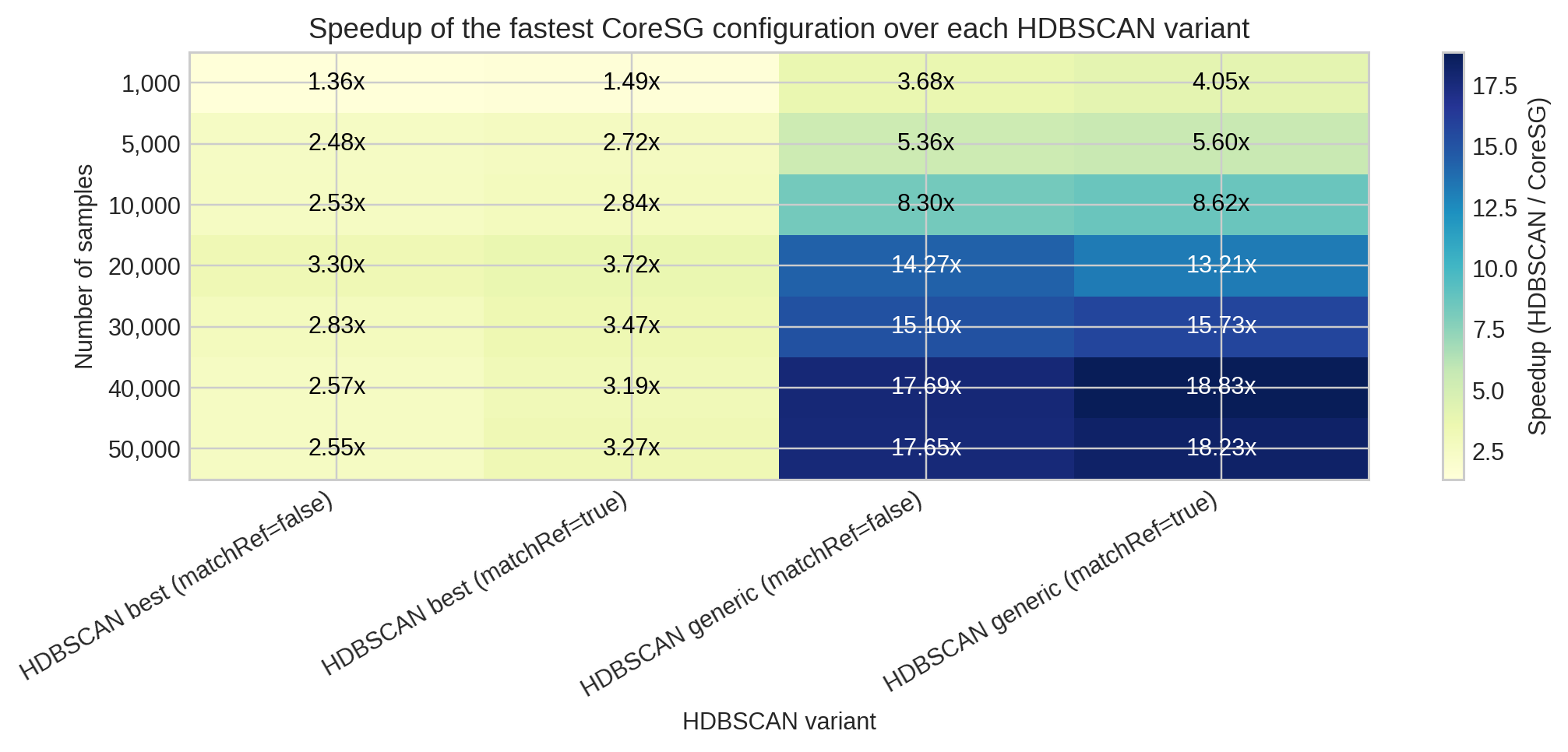
Interpret Core-SG results in terms of total analysis cost.
If a workflow needs one clustering result, the Core-SG build cost may not be
worth paying. If the workflow needs many k values over the same X, the
one-time build can be amortized by extraction reuse.
Exact CoreSG and ScoreSG answer different scaling questions. Exact CoreSG
shows the benefit of reuse when dense pairwise construction is still feasible.
ScoreSG should be used to evaluate the scalable approximate path once
n_samples makes dense construction too expensive. In the current benchmark
data, ScoreSG provides both lower cumulative runtime and a lower empirical
growth rate than exact CoreSG over the directly comparable sample sizes.
How to read the ScoreSG results
ScoreSG should be interpreted as the approximate scalable path, not merely as another implementation variant. The traditional exact CoreSG path demonstrates the build-once, extract-many idea, but it still pays for dense pairwise distance information. ScoreSG changes that construction regime by using an approximate sparse-neighbor graph.
The main ScoreSG findings are:
In the common interval from
N=5,000toN=50,000, optimized ScoreSG is the fastest method at every measured sample size.At
N=50,000, optimized ScoreSG takes224.36 sfor all49values ofk. Optimized exact CoreSG takes525.45 s, HDBSCANbesttakes1,342.44 s, and HDBSCANgenerictakes9,272.92 s.The empirical cumulative-runtime exponent for optimized ScoreSG is approximately
1.247in the common interval, compared with1.575for optimized exact CoreSG,1.601for optimized HDBSCANbest, and2.113for optimized HDBSCANgeneric.In the ScoreSG-only extended benchmark, optimized ScoreSG reaches
N=200,000with1,246.93 scumulative runtime and an empirical exponent near1.26.
The most important interpretation is that ScoreSG addresses the practical
n_samples limitation of exact CoreSG. If exact CoreSG is already feasible
and exact construction is preferred, it remains a useful baseline. If the
dataset is large enough that dense pairwise construction becomes the
bottleneck, ScoreSG is the method that should be considered first.
Extraction optimization also matters. At N=200,000, the reference ScoreSG
extraction path is approximately 6.09x slower than optimized ScoreSG.
Therefore, the observed speedup should be attributed to the combination of
approximate sparse graph construction and optimized repeated extraction.
Practical decision rule
Use the results as follows:
Use HDBSCAN directly when a single clustering run is enough and hierarchy reuse is not required.
Use exact CoreSG when repeated
kextraction is needed and dense pairwise construction is still acceptable for the targetn_samples.Use ScoreSG when repeated multi-
kanalysis is needed and sample size makes exact dense construction too expensive.
PyNNDescent and Score-SG results may show warm-up effects. Treat first-run timings carefully and prefer repeated measurements when reporting results.