Runtime Comparison
ScoreSG approximate path
ScoreSG should be included in the primary runtime comparison because it changes
the practical scalability limit of the traditional exact CoreSG path. Exact
CoreSG reuses work across many k values, but its construction still relies
on dense pairwise distance information. This makes it increasingly constrained
as n_samples grows. ScoreSG addresses that limitation by using an
approximate sparse-neighbor construction, avoiding the dense all-pairs stage
that dominates the exact path at larger scale.
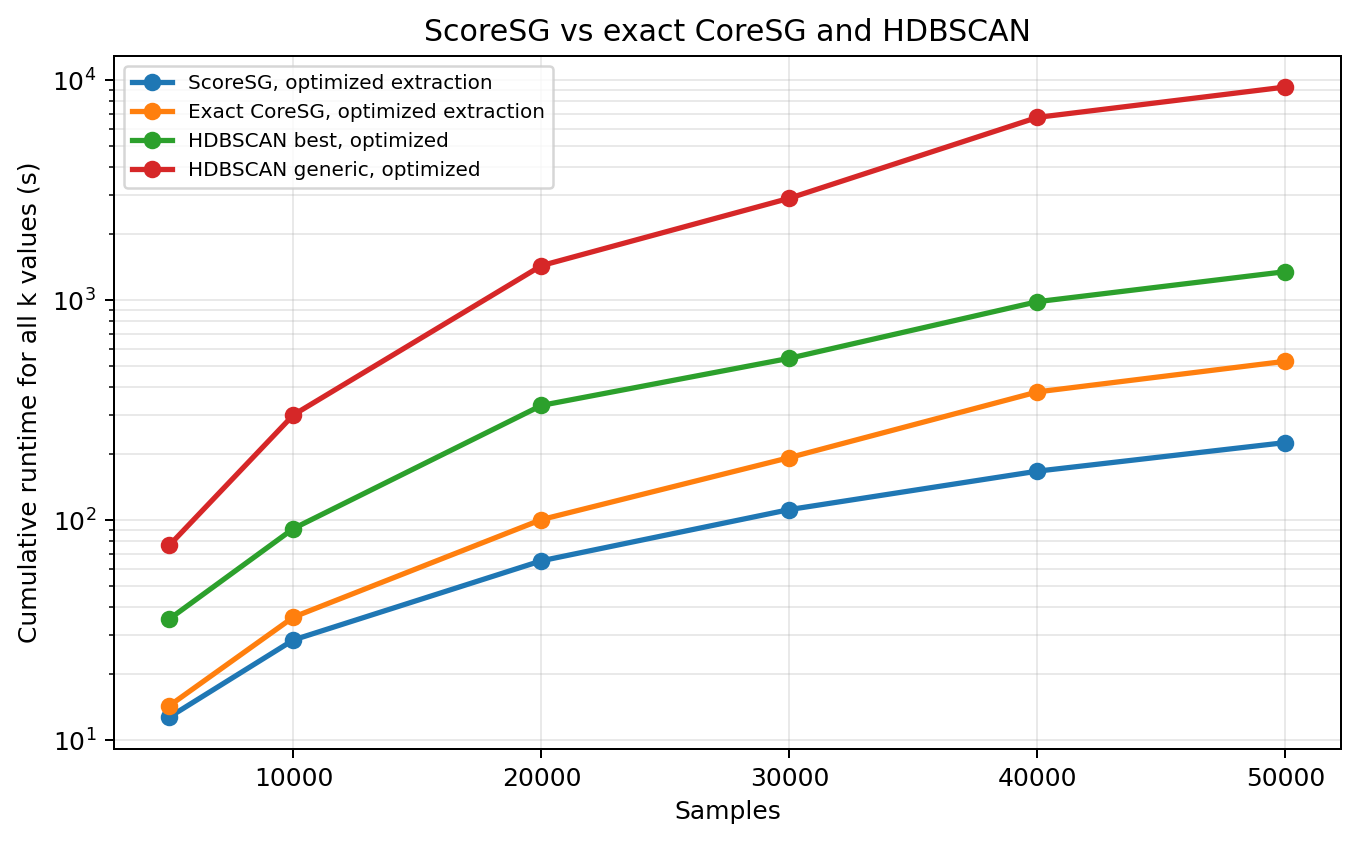
In the common benchmark interval from N=5,000 to N=50,000, ScoreSG with
optimized extraction is faster than optimized exact CoreSG and both HDBSCAN
baselines. At N=50,000, ScoreSG completes the full repeated multi-k
workflow in 224.36 s, compared with 525.45 s for optimized exact
CoreSG, 1,342.44 s for optimized HDBSCAN best, and 9,272.92 s for
optimized HDBSCAN generic.
This corresponds to approximately 2.34x speedup over optimized exact
CoreSG, 5.98x speedup over optimized HDBSCAN best, and 41.33x
speedup over optimized HDBSCAN generic at the largest directly comparable
sample size. The result is not merely a constant-factor improvement: ScoreSG
also shows a lower empirical growth rate in the benchmark, which is why it is
the preferred option when the exact dense construction becomes constrained by
sample size.
For the extended ScoreSG-only scaling results, see ScoreSG Performance Results.
Exact CoreSG and HDBSCAN baseline figures
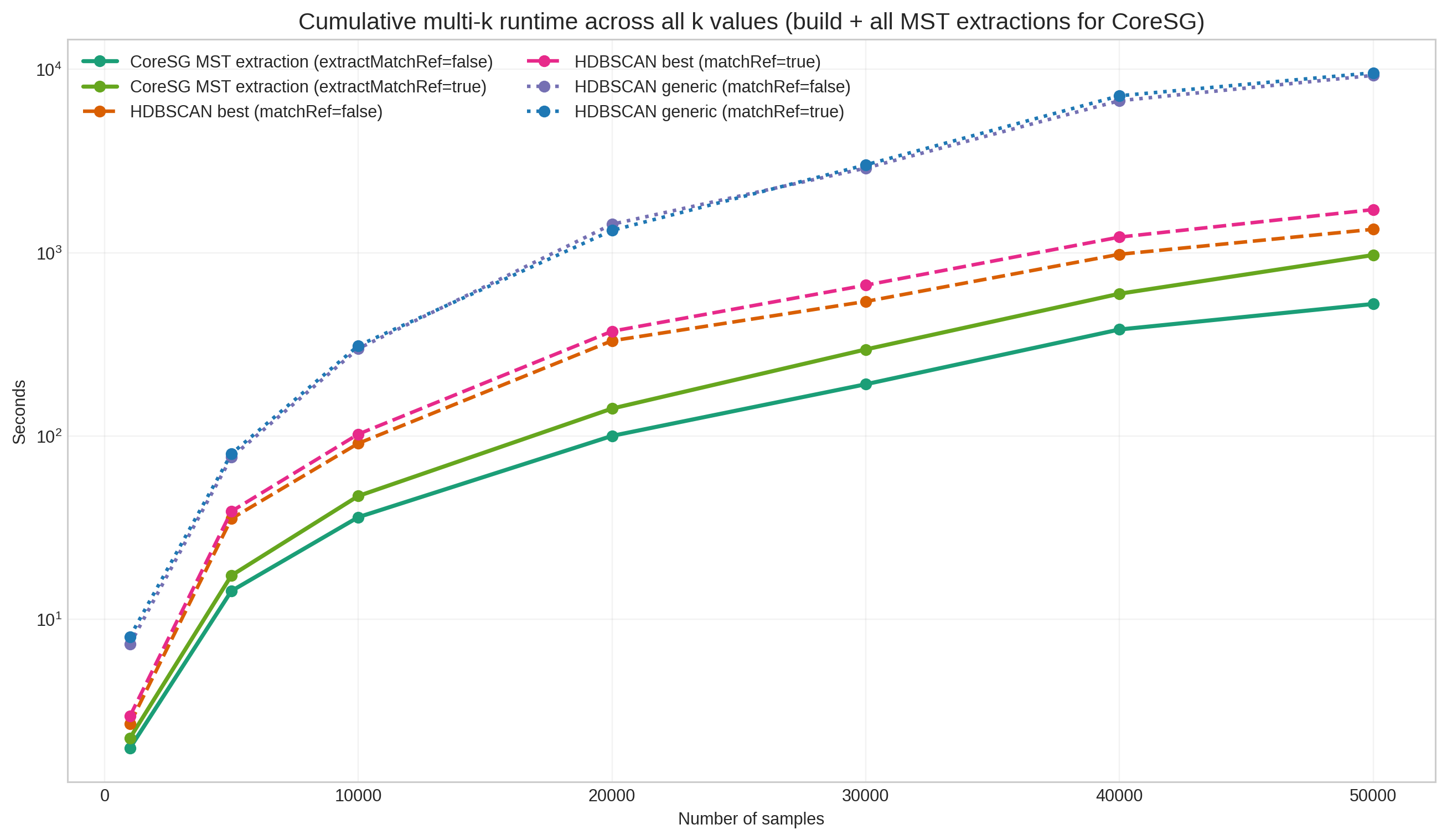
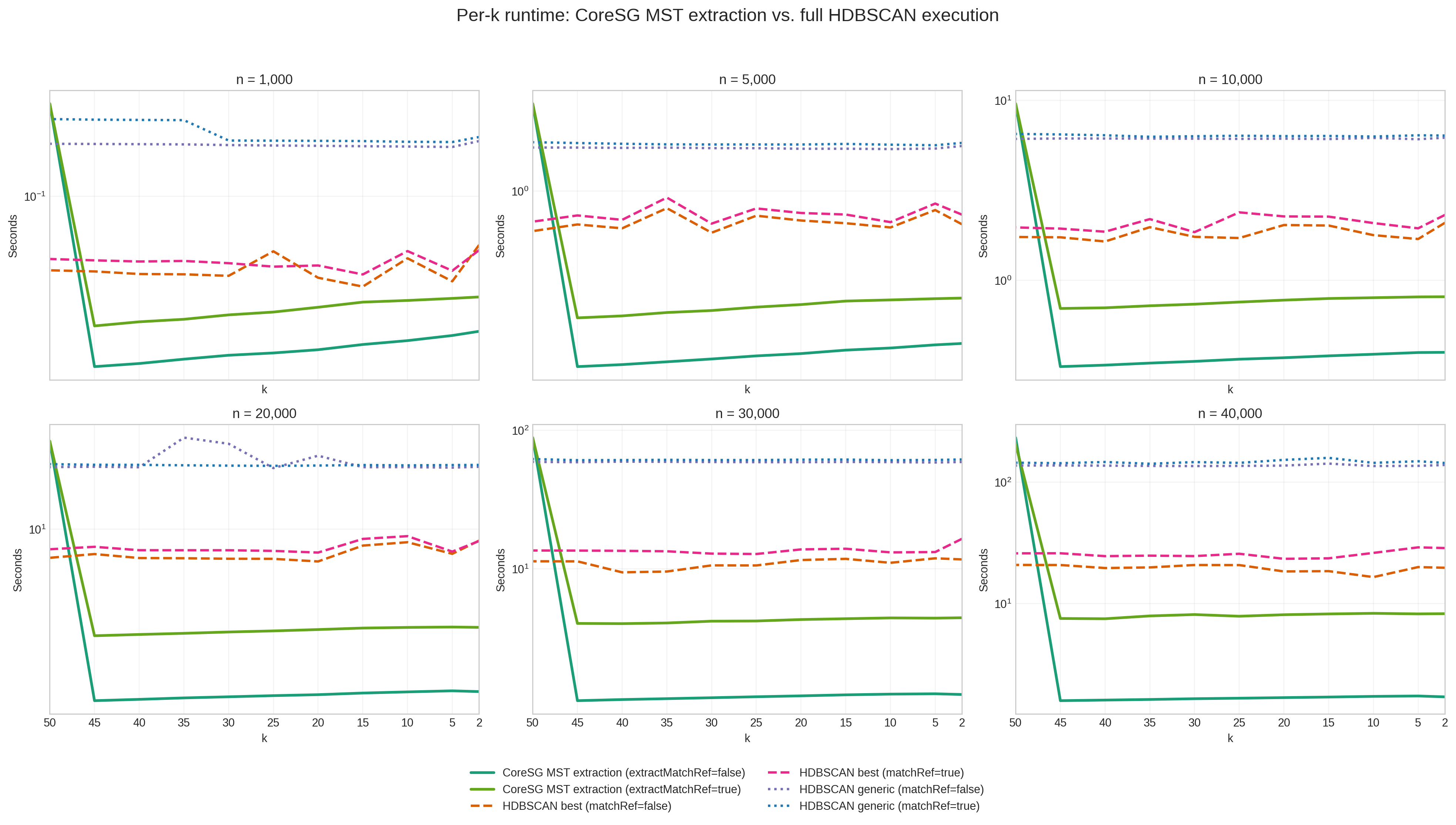
The cumulative view is the primary performance view for Core-SG because it charges the build step once and then sums repeated extraction work.
The per-k view is useful for seeing the initial build cost and the much
smaller extraction costs that follow.