Scaling
ScoreSG scaling results
ScoreSG is the strongest scaling result in the current benchmark suite. It is
the approximate path intended to relieve the exact CoreSG n_samples
limitation caused by dense pairwise distance construction.
In the common interval where ScoreSG, exact CoreSG, and HDBSCAN are all available, optimized ScoreSG has the lowest empirical growth exponent and the lowest cumulative runtime.
Method |
Empirical exponent |
Interpretation |
|---|---|---|
ScoreSG, optimized extraction |
|
Best observed scaling profile. |
Exact CoreSG, optimized extraction |
|
Reuse helps, but dense construction remains costly. |
HDBSCAN |
|
Strong HDBSCAN baseline, still recomputed for every |
HDBSCAN |
|
Near-quadratic cumulative behavior in the benchmark. |
At N=50,000, optimized ScoreSG completes the full 49-value workload in
224.36 s. The corresponding runtimes are 525.45 s for optimized exact
CoreSG, 1,342.44 s for optimized HDBSCAN best, and 9,272.92 s for
optimized HDBSCAN generic. This means the approximate ScoreSG path is not
only faster at one point; it also grows more slowly as N increases.
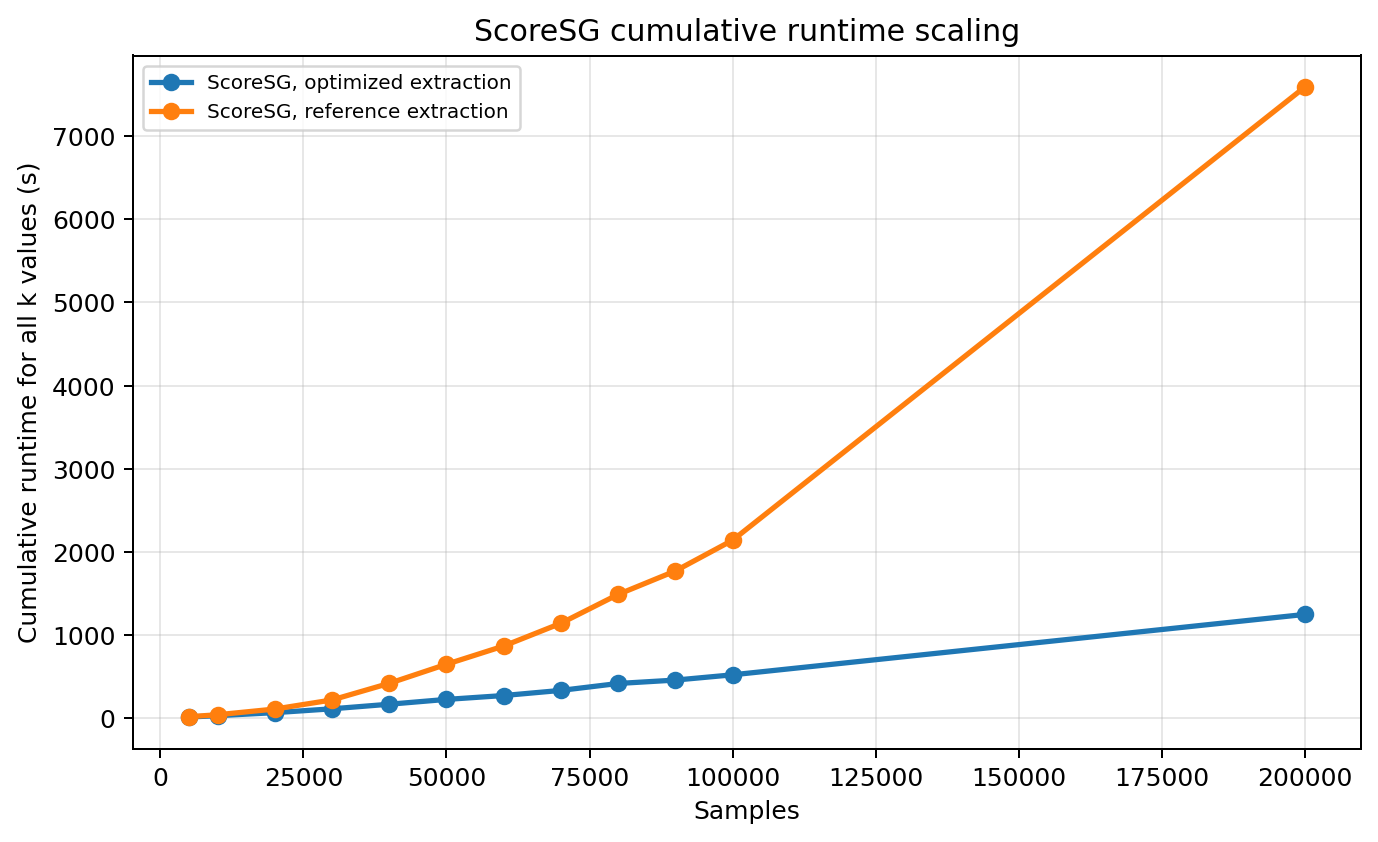
The ScoreSG-only extended benchmark reaches N=200,000 samples. In that
range, optimized ScoreSG keeps an empirical exponent near 1.26 and reaches
1,246.93 s cumulative runtime at N=200,000. The same run decomposes
into 54.92 s of construction and 1,192.01 s of cumulative extraction,
showing that after many requested k values the extraction phase dominates
the total cost.
The reference extraction path is much less scalable. At N=200,000, it
reaches 7,592.37 s, approximately 6.09x slower than optimized ScoreSG.
This is an important implementation insight: the approximate graph
construction is necessary, but the optimized extraction routine is also
essential for preserving the favorable scaling behavior.
Exact CoreSG scaling baseline
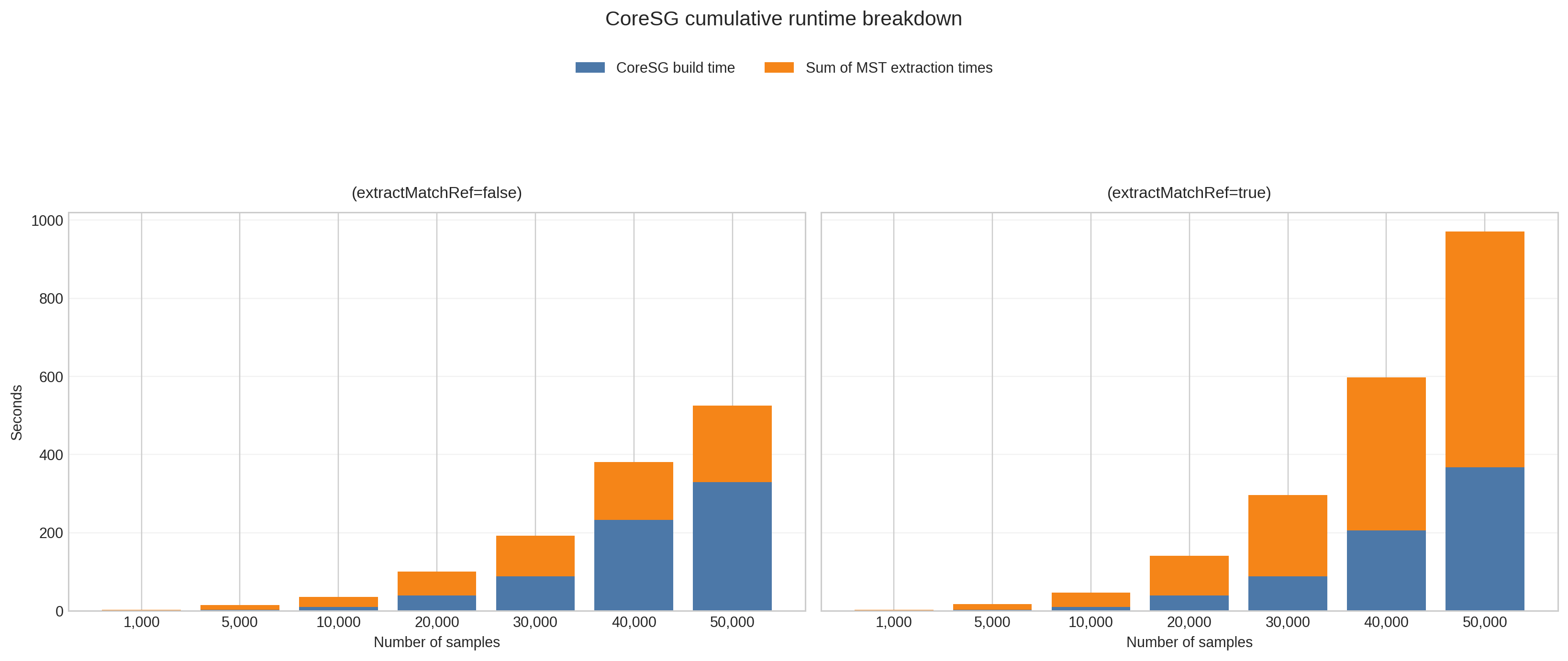
Core-SG scaling depends on the cost of support graph construction and the cost of repeated MST extraction.
The build stage typically dominates cumulative Core-SG cost. The value of the
method comes from avoiding repeated full builds for every target k.
Score-SG is designed to avoid explicit dense all-pairs distance construction, but it should still be interpreted empirically because approximate nearest neighbor behavior depends on data geometry, metric choice, and PyNNDescent parameters.
In the current benchmark suite, ScoreSG with optimized extraction shows the
most favorable scaling profile among the measured methods. Over the common
comparison interval, the cumulative runtime grows approximately as
O(N^1.25). By contrast, optimized HDBSCAN best grows around
O(N^1.60) and optimized HDBSCAN generic grows around O(N^2.11).
The ScoreSG-only extended benchmark up to N=200,000 keeps a similar
empirical exponent, approximately 1.26.
See ScoreSG Performance Results for the ScoreSG tables and figures.